

Fossil
VS Non-Fossil
International agreements
Kyoto Protocol
The Kyoto Protocol is an international treaty formed at a conference in Kyoto, Japan, by the ‘United Nations Framework Convention on Climate Change’(UNFCCC). This treaty involves countries agreeing to reduce their country's greenhouse gas emissions. The Kyoto Protocol was adapted in 2005 and is still running. So far there has been two commitment periods. In the first period 37 industrialised countries joined the commitment and committed to reduce 5% of their countries greenhouse gas emissions. In the second commitment those countries committed to reduce 18%. Some countries were successful and some were not.
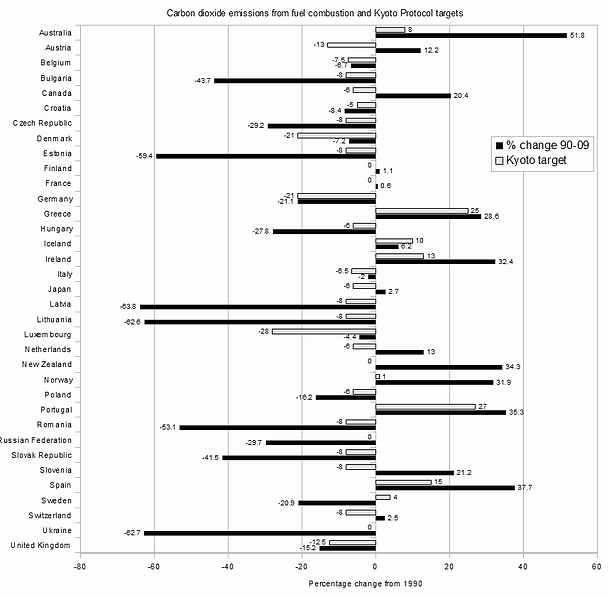
Graph of first commitment period results
The Bali Road Map
The Bali Road Map was adopted by the UNFCCC at the 13th Conference of the Parties in December 2007 in Bali. At the convention all parties were involved in crafting the Bali Road Map(BRM). The BRM was set out to make forward-looking decisions on what needs to be done to reach a secure climate future. The BRM includes the Bali action plan which is divided into five categories. These categories are shared vision, mitigation, adaption, technology and financing.
Copenhagen
The Copenhagen accord was adapted by the UNFCCC in 2009. Under the accord, global leaders decided for the first time to do the following:
-Hold any increase in global temperature to below 2 degrees Celsius
-Specify, side by side, emissions targets for developed countries and actions to reduce emissions by developing countries
-A framework for national and international monitoring of what developed and developing countries will do
-Considerable financing to support emissions reductions and adaptation in developing countries.
The Accord includes developed-country commitments to collectively provide new and additional resources approaching USD 30 billion over the next three years. And, in the context of meaningful actions to reduce emissions in their country.